
M2M
Professionalizing
Sanitation Service Delivery in Urban India
Urban India’s sanitation landscape relies on a range of services –collecting and processing garbage, sweeping streets, cleaning public toilets, and managing faecal sludge. Delivering these sanitation services safely and professionally is central to achieving the goals of Swachh Bharat Mission-Urban 2.0 (SBM-U 2.0).
The Ministry of Housing and Urban Affairs (MoHUA), in collaboration with WASH Institute, has compiled a set of initiatives that will help cities deliver professional sanitation services. These align with existing ‘Manhole to Machine-hole’ initiatives such as Safaimitra Suraksha, the NAMASTE scheme and other Government of India initiatives. They include guides, case studies, model documents, Standard Operating Procedures (SOPs), templates, and training materials that will aid cities professionalize their sanitation delivery.
What is professional sanitation service delivery?
Professional sanitation services delivery refers to a safe, efficiently designed, standards-driven approach to waste management, that is delivered by accountable institutions through well-trained, aptly equipped, and fairly compensated workers.
To professionalize sanitation services is to achieve public health and environmental outcomes in a safe, dignified, and financially sustainable manner. This goal requires a virtuous cycle of service delivery for increased citizen satisfaction leading to improved cost recovery, sustained by benchmarks and continuous improvement.
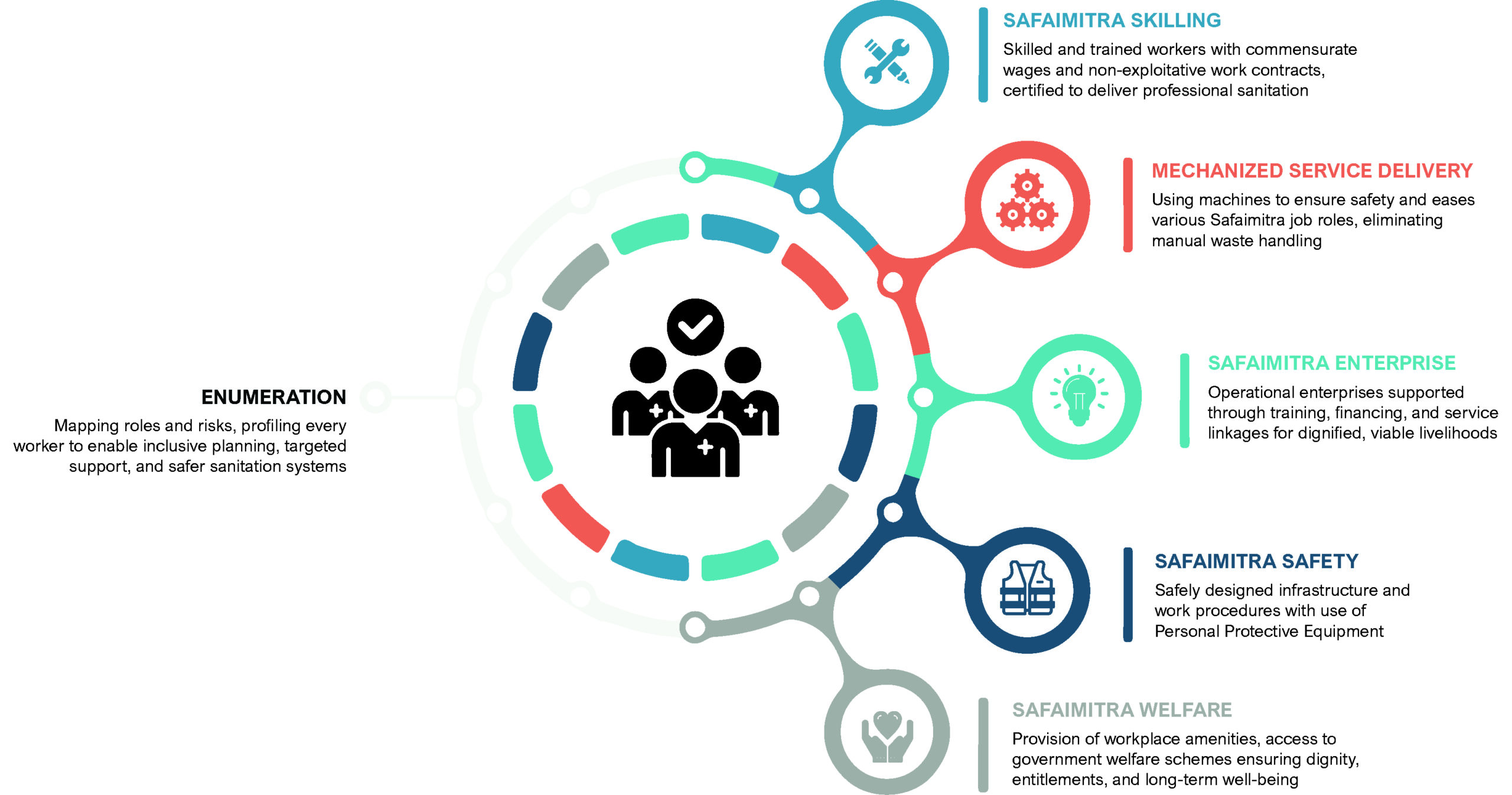
There are five themes under which initiatives for professional sanitation service delivery can be categorized.
Ultimately, professionalizing sanitation is about treating sanitation as a core public service – demanding a level of competence, care, and oversight, the same as any essential utility.
Prerequisites for Professional Sanitation Services
Worker Enumeration
ULBs should begin by listing all types of sanitation roles in their area – toilet caretakers, sweepers, drain and sewer cleaners, desludging staff, and waste pickers, etc. Each worker should be digitally profiled with key details like job role, employer, employment type, skill level, gender, caste, safety equipment, and welfare coverage.
Sewer and septic tank workers (SSWs) and Waste Pickers are covered for enumeration under the NAMASTE Scheme. It is recommended that the ULB enumerate all other sanitation job roles in a similar manner. This helps in targeting the right groups for welfare, safety, and skill interventions.
RESOURCES:
- Sanitation Worker Project | Animation from Dalberg
- Safai Mitra Roles
- SOP _Safety & Dignity of Safai Mitras in Rural India
- NAMASTE Profiling Camp Prerequisites.pdf
- NAMASTE SOP for Organizing Survey & Profiling Camp.pdf
- Safai Mitra Profiling Process.jpg
- City-level quantification and profiling of Safai Mitras.pdf
CASE STUDY:
Stakeholder Mapping
Since Safai Mitras are hired by ULBs, "Private Sanitation Service Organizations (PSSOs), Civil Society Organizations (CSOs/SHGs/NGOs), or even self-employed, it is important to identify their employer. This ensures that the right entity is made responsible for training, safety, and post-training support.
ULBs must also identify all other stakeholders involved in sanitation service delivery – ULB departments, contractors, NGOs, training agencies, and worker collectives – to coordinate and include them in various initiatives and understand their roles in enabling sanitation-linked livelihoods.
CASE STUDY:
Welfare Scheme Linkages
After profiling, ULBs should connect workers to relevant welfare schemes – covering health insurance, accident cover, and education support
for children. They should also ensure that all Safai Mitra have active Aadhar-linked bank accounts to enable direct payment and benefit transfers.
RESOURCES:
Since Safai Mitras are hired by ULBs, "Private Sanitation Service Organizations (PSSOs), Civil Society Organizations (CSOs/SHGs/NGOs), or even self-employed, it is important to identify their employer. This ensures that the right entity is made responsible for training, safety, and post-training support.
ULBs must also identify all other stakeholders involved in sanitation service delivery – ULB departments, contractors, NGOs, training agencies, and worker collectives – to coordinate and include them in various initiatives and understand their roles in enabling sanitation-linked livelihoods.
CASE STUDY:
After profiling, ULBs should connect workers to relevant welfare schemes – covering health insurance, accident cover, and education support
for children. They should also ensure that all Safai Mitra have active Aadhar-linked bank accounts to enable direct payment and benefit transfers.
RESOURCES:
Planning for Worker Initiatives
ULBs should assess the current skill levels and business readiness of Safai Mitra, including awareness of financial processes and willingness to take loans. Based on this, ULBs can design training programs and support workers in starting or joining sanitation enterprises.
Special focus should be given to women’s SHGs, those with prior experience, those willing to engage, and those in hazardous roles.
CASE STUDY:
ULBs must review the availability, condition, and usage of current safety equipment – including PPE, rescue tools, and safety SOPs.
ULBs shall also prepare an inventory of all sanitation equipment and vehicles in use – suction emptiers, jetting machines, waste collection trucks, etc. Information on ownership, condition, usage, and maintenance should be recorded. This will help identify utilization levels (overuse/idle machines), urgent replacement needs, asset conditions, and estimate new equipment numbers.
To estimate new equipment requirements, ULBs must consider the population served, kinds of waste generated across job roles, and types of sanitation systems used.
RESOURCES:
ULBs should carry out rapid assessments to identify where and how sanitation workers are exposed to physical, chemical, or biological risks – particularly during manual waste handling and confined space entry.
Mapping septic tanks, manholes, and drains helps prioritize mechanization and enforce safe entry protocols. This data should feed into safety planning
and routine monitoring to reduce occupational hazards.
CASE STUDY:
Safai Mitra Skilling
Skilling helps Safai Mitras follow proper procedures at work and ensure safety. Sanitation work is role-based; understanding these roles can help cities plan the right kind of training for each worker, targeted skilling interventions, prepare a training calendar, allocate budgets, and partner with credible training institutions.
Local governments should provide regular, structured training to help Safai Mitras use equipment safely, follow safety protocol, and improve their communication and hygiene practices. With the right investments, ULBs can build a sanitation workforce that is not just functional, but skilled, safe, and respected.
Worker Enumeration
To build on existing capacities, ULBs should document what training their workers have already undergone. This includes technical training, safety protocols, and soft skills, and helps determine who may qualify for Recognition of Prior Learning (RPL).
Cities must also evaluate whether workers contractors are trained to operate sanitation equipment.
In case of low skills readiness, ULBs shall integrate machine-specific training into their skilling plan.
RPL is a way to certify existing skills without undergoing full-length training. Cities should identify workers who are already experienced and can benefit from this pathway.
Compare the actual skills of workers in each role against what is required for safe and efficient service delivery. Shortlist workers who already have the required skills but lack formal certification and can benefit from RPL.
CASE STUDY:
Workers may need to learn new skills as the city implements various initiatives such as mechanization, worker’s enterprises, sewer entry professionals etc. Identify workers who will require structured training under certified programs.
Skilling should not happen in isolation. They must be integrated with other sanitation reforms – like mechanization, PPE use, safety audits, welfare schemes and enterprise formation – to build a truly professional system.
RESOURCES:
CASE STUDY:
Based on the assessment of existing skills and job roles, ULBs must select training modules that match job requirements.
Provide periodic and structured training programs to Safai Mitras in small batches, aligned with National Council for Vocational Education and Training –identified job roles and curriculum.
These can be drawn from sector-specific modules aligned with various Safaimitra job roles (PM-DAKSH, SBM-U approved modules, Model Curricula issued by SCGJ, etc.).
RESOURCES:
Training must lead to formal recognition and employment/self-employment opportunities. Planning for certification, toolkits, and wage improvement is crucial for long-term impact.
Machine operation training is crucial for long-term mechanization. ULBs should include short-term or RPL programs for existing workers. These should cover machine use, safety protocols, and basic maintenance, and be delivered through accredited training partners.
RESOURCES:
CASE STUDY:
Planning & Resource Allocation
Professional skilling efforts require strong institutional capacity within ULBs and State departments. Under SBM-U 2.0, officials are encouraged to complete certified modules via the Swachh Bharat e-Learning Portal and participate in refresher/advanced academic programs, all funded through capacity building provisions.
To deepen and sustain this institutional capacity, the Swachhata Margdarshak model builds an internal cadre of professional trainers across States and ULBs. Nominated officials are trained by MoHUA and Swachhata Knowledge Partners (SKPs) to serve as knowledge champions and lead capacity building within their assigned ULBs. Margdarshaks, in turn, support ULBs by guiding staff on certifications, digital tools, safety protocols, and best practices.
RESOURCES:
- Swachh Bharat e-Learning Portal
- Course 208: Mainstreaming Waste Pickers in SWM
- Course 209: Mainstreaming Waste Pickers in SWM
CASE STUDY:
Dedicated budgeting is necessary for training costs and material, PPE procurement, logistics, and post-training support. Without this, skilling activities may be delayed or inconsistently delivered.
Funds allocated for Safai Mitra skilling programmes should include cost of trainers, venues, PPE kits, and printed materials, in line with the Common Cost Norms for Skill Development Schemes, issued and periodically revised by the Ministry of Skill Development and Entrepreneurship. Training costs are also eligible under SBM-U 2.0 capacity building funds, and via DAY-NULM or PM-DAKSH schemes.
RESOURCES:
CASE STUDY:
ULBs should carry out rapid assessments to identify where and how sanitation workers are exposed to physical, chemical, or biological risks – particularly during manual waste handling and confined space entry.
Mapping septic tanks, manholes, and drains helps prioritize mechanization and enforce safe entry protocols. This data should feed into safety planning
and routine monitoring to reduce occupational hazards.
CASE STUDY:
Cities should identify experienced training agencies, NGOs, or NSDC/SSC-affiliated centers to conduct high-quality training for Safai Mitras. This ensures programs adhere to national standards and ensure certified workers.
ULBs may also engage Swachhata Knowledge Partners (SKPs) empaneled by MoHUA to design and deliver Safai Mitra training. These partners bring technical expertise and experience in sanitation service delivery, ensuring high-quality, context-specific training.
Training costs are eligible under SBM-U 2.0 capacity building funds.
RESOURCES:
CASE STUDY:
Mechanization of Sanitation Service Delivery
Professionalizing sanitation services is impossible without replacing hazardous manual tasks with safer, machine-based operations. Mechanization is a legal mandated under the Prohibition of Employment as Manual Scavengers and their Rehabilitation Act (MS Act 2013), and critical for cities seeking Safaimitra Surakshit Sheher (SSS) certification.
Local governments must systematically assess where mechanization is needed and prepare a time-bound plan to adopt suitable equipment and vehicles. Workshops and awareness sessions with engineers, supervisors, contractors, and Safai Mitras should reinforce the legal mandate for mechanization.
Mechanization reduces emergency costs, improves service quality, and unlocks central funding and certification incentives. With the right planning and financing, cities can move toward 100% mechanized sanitation operations – embedding professionalism, safety, and dignity at every step.
Institutional & Ecosystem Enablers
ULBs should prepare a detailed financial plan to support mechanization, factoring in operator training and maintenance costs.
The NAMASTE scheme promotes mechanization by encouraging ULBs to fund cleaning machines under SBM-U 2.0 AND AMRUT schemes.
RESOURCES:
To ensure safety and accountability, ULBs must compulsorily license operators, and establish clear contracts, service standards, and monitoring systems.
For more details see section on Enterprises.
CASE STUDY:
ULBs can contract licensed PSSOs by signing Annual Maintenance Contracts (AMCs) with clear SLAs for mechanized sanitation services, and skilled certified workers. Also dedicate O&M budgets to maintain ULB-owned vehicles.
ULBs must track how machines are used, whether they are replacing unsafe practices, and how worker safety improves.
RESOURCES:
CASE STUDY:
transition incentives and clearly communicating legal obligations.
It is equally important to reassure Safai Mitras that mechanization is not about job loss but about making their work safer, more dignified, and better compensated through formal roles and skill recognition.
RESOURCES:
CASE STUDY:
Mechanization Gaps and Equipment Selection
ULBs must evaluate present mechanization levels for each job role, compare it with what is required, and identify critical service and safety gaps.
- Using the gap analysis, ULBs should prioritize machine investment based on risk exposure, urban coverage, operational urgency and cost-benefit. High-risk tasks (like sewer entry) and densely populated areas urgently need mechanized alternatives.
- Determine whether existing equipment is underused, overburdened, or replaced by unsafe manual labour without proper safety gear.
Such an assessment will define the scope and priorities for mechanization across the sanitation value chain.
RESOURCES:
- CPHEEO Calculator: Equipment and Workforce requirements
- SOP for Desludging Operators who Undertake Mechanized Desludging of STPs
- SOP for Mechanized Desludging of Septic Tanks in Tamil Nadu (Part II Service Seeker)
- SOP for Mechanized Desludging of Septic Tanks and Sewer Network in Tamil Nadu (Part IV Event of Post-Accident)
CASE STUDY:
ULBs should identify appropriate machines for each sanitation service, based on the earlier assessment.
The goal is to ensure a functional fit between the sanitation task and the machine, considering factors like type and volume of waste handled, frequency of operation, availability of trained operators, funding, and maintenance services.
Identifying constraints – like narrow lanes or hilly terrain – helps cities select context-appropriate machinery, such as mini-jetting and suction units, incinerators, composting units, etc.
To address local needs efficiently, ULBs are encouraged to use the Government e-Marketplace portal, a centralized public procurement platform that offers a wide range of sanitation equipment, tailored to diverse urban conditions.
RESOURCES:
CASE STUDY:
Safai Mitra Enterprise Formation
Functional sanitation infrastructure and professional services require an ‘ecosystem of care’ that prioritizes proper operation and timely maintenance. Where ULBs are unable to manage these functions directly, it becomes essential to promote sanipreneurship — enabling PSSOs, community-based Self-Help Groups (SHGs), and Safai Mitras to take the lead.
ULBs can link budding sanipreneurs to enterprise schemes, help prepare viable business plans, and coordinate training and ongoing support via financial institutions and SKPs. Several schemes back this effort: the Swachhta Udyami Yojana (SUY) provides financial assistance for sanitation vehicles, sanitary marts, and community toilet operations; DAY-NULM mandates that 10% of SHGs be composed of sanipreneurs; and the NAMASTE scheme offers subsidized mechanized equipment and handholding support via empanelled agencies.
Mapping Services to Private Sanitation Service Organizations (PSSOs)
With a clear understanding of worker needs and local context, cities can now plan interventions.
ULBs must select context-specific viable enterprises, based on sanitation needs, while focusing on models that address service gaps or improve current delivery.
Define enterprises that will be supported, budget for training and equipment, and identify convergence with central schemes. ULBs should prepare project plans that include:
- Training and skilling pathways
- Business plan development
- Integration of enterprise-led service delivery into ULB operations
- Loan Facilitation
This will ensure that enterprise promotion is backed by sufficient resources.
RESOURCES:
CASE STUDY:
Licensing, Tariffs, and Call Centres
ULBs should put in place regulations to ensure that only licensed and compliant sanitation service providers operate within their jurisdiction.
Licensing formalizes enterprises, enabling them to access contracts, financing, and government schemes, while also ensuring accountability to service standards and public safety.
ULBs should establish clear, transparent tariff structures for services like desludging and toilet usage. These tariffs must be included in contracts, publicly communicated, and designed to balance user affordability with financial sustainability for ULBs and PSSOs.
Cities should integrate sanitation services such as desludging and solid waste management into centralized platforms like the 14420 helpline. This ensures easy access for citizens, timely complaint resolution, and improved tracking and monitoring of service delivery.
CASE STUDY:
Contracts with Service Level Agreements
ULBs must review and strengthen existing PSSO contracts to include clear enforceable SLAs. These SLAs must define measurable service benchmarks, ensure mandatory training and safety provisions for Safaimitras, guarantee fair remuneration, and link payments to performance.
CASE STUDY:
To operate formally, Safai Mitra enterprises must be registered under suitable legal entities such as Self-Help Groups (SHGs), cooperatives, etc. This step ensures that enterprises have access to financial services, government schemes, and ULB contracts.
New enterprises can be formally contracted by ULBs or empaneled as vendors for sanitation-related services. This strengthens institutional ownership and service reliability.
CASE STUDY:
Enterprise Support for Workers’ Collectives
ULBs may utilize SKPs to deliver practical training to help workers understand enterprise operations, service delivery standards, and financial planning. ULBs should also organize practical training on bookkeeping and customer management.
Such training will help sanipreneurs draft business plans tailored to local needs. Plans should include operational needs, cost estimates, cash flows, loan requirements, and repayment capacity. This will inform loan applications and subsidy access.
CASE STUDY:
Access to finance and tools is essential for a sanitation enterprise to function. This step connects beneficiaries to schemes like Swachhta Udyami Yojana and NSKFDC loans and subsidies.
ULBs shall facilitate access to credit through schemes like Swachhta Udyami Yojana or NSKFDC loans. ULBs will also help ensure that sanitation equipment is procured and deployed.
CASE STUDY:
Providing ongoing mentorship for at least 12–18 months can improve how sanipreneurs manage cash flow, resolve conflict, access the sanitation market, and navigate government systems. ULBs can partner with NGOs, SKPs or Swachhata Margdarshaks to provide guidance and help troubleshoot issues.
CASE STUDY:
Safai Mitra Safety
Sanitation work, especially in confined spaces like sewers and septic tanks, involves serious health and safety risks. Sanitation safety begins with eliminating hazardous practices, and building systems – clear procedures, designated supervisory roles, and strong institutional accountability – that ensure safe, regulated, and dignified work conditions.
ULBs should structure a safety approach that uses the Hierarchy of Controls: eliminate risks where possible, apply engineering and administrative safeguards, and ensure the consistent provision and use of Personal Protective Equipment (PPE). ULBs also must conduct regular audits that uphold legal safety compliances and public trust.
Pillar 1: Application of the Hierarchy of Controls
Hierarchy of Controls
The safest approach to sanitation work is eliminating the need for human entry altogether.
For properly designed systems, machine-based sanitation, and regular preventive maintenance for equipment and infrastructure, will reduce hazardous manual interventions.
Cities should also prioritize identifying and retrofitting poorly designed sanitation systems, such as insanitary toilets.
RESOURCES:
- De-sludging Operators _An Assessment of Occupational Safety in Two Indian Cities.pdf
- Twin-pit technology
CASE STUDY:
In situations where manual entry cannot be avoided, engineering controls must be used to protect workers. Specifically, gas detectors, air blowers for ventilation, communication kits, safety tripods, winches, and explosion-proof lights make confined space work safer.
RESOURCES:
ULBs should issue SOPs for all sanitation services, while strictly enforcing safety protocols. Existing SOPs should be reviewed to identify areas for safety improvement.
ULBs should notify and train Duty Supervisors to provide field oversight during hazardous sanitation tasks.
Cities must also organize regular refresher trainings, establish grievance redressal systems, and strengthen worker confidence in such mechanisms.
RESOURCES:
- SOP for Desludging of Septic Tanks.pdf
- SOP for Desludging Operators who Undertake Mechanized Desludging of STPs.pdf
- SOP for Mechanized Desludging of Septic Tanks in Tamil Nadu (Part II Service Seeker).pdf
- SOP for Mechanized Desludging of Septic Tanks and Sewer Network in Tamil Nadu (Part IV Event of Post-Accident).pdf
CASE STUDY:
PPE works in tandem with other safety measures, including engineering and administrative controls. Providing appropriate PPE – gas masks, gloves, boots, helmets, and harnesses – is essential to protect Safai Mitras. ULBs must conduct fit testing, maintain a PPE replacement schedule, and train workers on correct usage.
ULBs can also use the SRMS Dashboard to track the distribution, condition, and timely replacement of PPE.
RESOURCES:
- Development of Specifications and Standards on PPE for Safai Mitras.pdf
- Handbook for Safai Mitras on the use of PPE.pdf
- Field Handbook _Sizing Guide for Sanitation Workers.pdf
CASE STUDY:
Pillar 2: Emergency Response Sanitation Unit (ERSU)
Institutionalizing ERSU
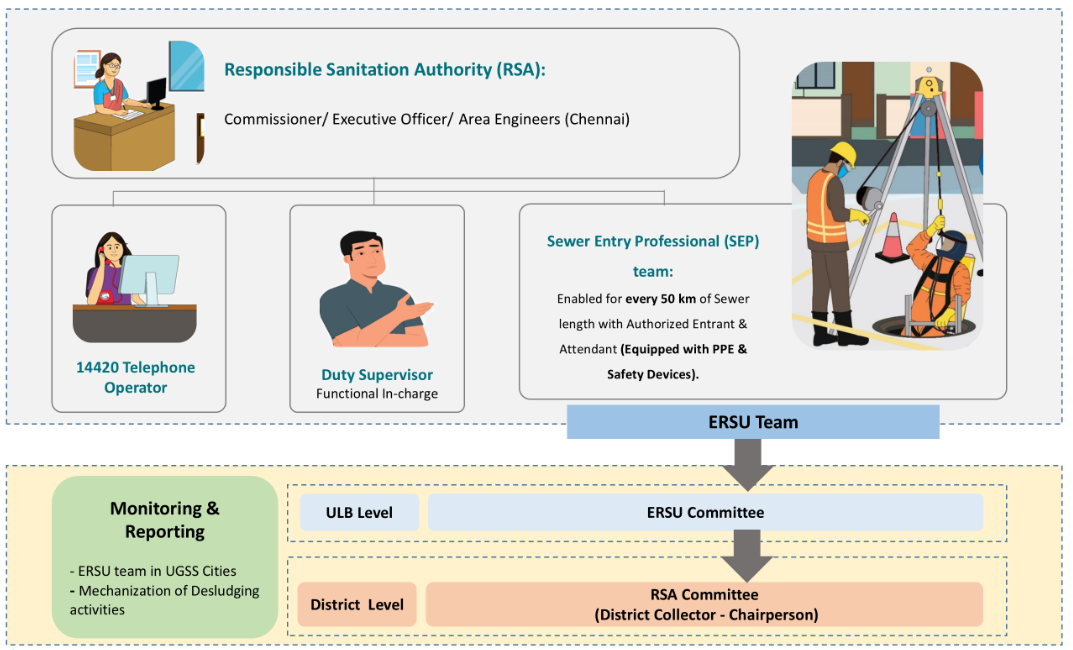
The ERSU is an emergency unit designed for safe, legal human entry into sewers, septic tanks, or other confined spaces, only when mechanical options fail. In tandem with the ERSU unit, cities shall operationalize a centralized hotline number (14420) for single-window desludging services.
ERSU personnel are medically fit and trained in confined space safety, rescue, and use of PPE. Where needed, ULBs can partner with licensed private operators to provide trained SEPs, supervisors, and certified equipment for the ERSU.
RESOURCES:
CASE STUDY:
SEPs are trained Safai Mitras who are physically fit and skilled in safe confined space entry protocols. ULBs must maintain a minimum SEP-to-infrastructure ratio of 2 SEPs per 500 septic tanks, or for every 50 kms of sewer line.
RESOURCES:
ULBs must establish regular monitoring and course correction for the ERSU. Safety indicators – PPE usage rates, the number of trained SEPs, frequency of confined space entries, etc. – should be tracked consistently through audits and field reports.
RSAs and Duty Supervisors must review these inputs periodically to identify gaps, update SOPs, and refine training programs. Feedback from Safai Mitras and analysis of incident records should directly inform safety upgrades.
ULBs may align reporting with the Safaimitra Surakshit Sheher certification framework.
RESOURCES:
CASE STUDY:
Human Resources & Roles
The RSA, typically the District Collector, oversees safe sanitation operations in their jurisdiction. RSAs ensure compliance with legal provisions and monitor implementation of safety protocols and mechanization efforts. They coordinate emergency responses and ensure that only trained personnel with proper equipment are allowed entry into confined spaces.
RESOURCES:
The Duty Supervisor ensures each sanitation emergency is assessed, approved, and safely executed. Supervisors will ensure safety equipment availability, oversee team deployment, halt unsafe work, and report completion to the RSA.
Sewer Entry Professionals (SEPs) are trained in hazard recognition, emergency procedures, and equipment use – and work as part of a tag team consisting of a Top Man and Authorized Entrant.
The Authorized Entrant enters the confined space, while the Top Man remains outside the space, monitoring the SEP’s condition, maintaining communication, and initiating rescue if needed.
All SEPs and Supervisors must undergo certified safety training, including practical confined space entry and rescue simulations. Regular refresher courses and drills help maintain operational readiness.
RESOURCES:
- Guidelines for Safai Mitra.pdf
- Training Manual for Setting up ERSU
- Safety Training for Sewer Entry Professionals (Trainer's Manual)
CASE STUDY:
Additional Resources:
Safai Mitra Welfare
The Supreme Court’s 2023 directions on compensation, rehabilitation, and national-level tracking of sewer deaths make institutional accountability for sanitation services non-negotiable. Cities must move beyond reactive responses to worker injuries or deaths and proactively embed worker welfare into city systems to ensure fair wages, legal safeguards, and access to entitlements and long-term support. Safai Mitra Welfare can be attained by leveraging structured policies on insurance, education support, employment for next of kin, and comprehensive rehabilitation plans.
Access to Welfare Entitlements
Workers should be trained under PM-DAKSH, DAY-NULM or SBM-supported initiatives. RPL and certification can help formalize their roles, increase employability, and serve as an entry point into enterprise-formation.
RESOURCES:
ULBs shall link sanitation workers and SHGs to financial institutions, credit schemes, and capital subsidies – especially through NSKFDC and DAY-NULM.
RESOURCES:
ULBs should use digital platforms like the Safaimitra Resource Management System to track key welfare indicators, including scheme linkage, safety equipment coverage, training and skilling uptake, and grievance redressal.
To strengthen accountability, a dedicated ULB-level Safai Mitra Welfare Officer (or NAMASTE ULB Nodal Officer) may be appointed to monitor scheme linkage. This institutionalizes welfare measures and provides a point of contact for sanitation workers to report their grievances.
CASE STUDY:
Dignity and Protection at Work
ULBs must conduct regular audits to monitor wage payments, formalize worker roles wherever possible to ensure job security, and establish clear grievance redress mechanisms through helplines or designated officers.
RESOURCES:
CASE STUDY:
ULBs shall design rest facilities for Safai Mitras, provided with basic amenities such as access to clean drinking water, rest areas, and hygiene facilities; this includes areas for uniform changes, meals, and other conveniences.
ULBs must also ensure that workers receive well-fitting PPE (with the option to replace damaged PPE) to maintain safety and comfort during sanitation operations.
ULBs shall conduct health camps to screen for pre-existing diseases, and to make sanitation workers and their families aware of occupational hazards and healthy lifestyles.
RESOURCES:
CASE STUDY:
ULBs should monitor for any form of caste- or occupation-based discrimination, whether at the workplace, or in interactions with citizens. Safai Mitra can be promoted through inclusion in city events and campaigns, recognizing their contributions in citizen forums, and ensuring that they are meaningfully involved in decision-making.
Information, Education, and Communication (IEC) activities should aim to foster greater understanding and respect for Safai Mitra contributions.
RESOURCES:
In the unfortunate event of a Safai Mitra’s injury or death, ULBs must act swiftly and compassionately to support the affected family, in line with Supreme Court orders. Immediate support should include a job for the next of kin, counselling services, and access to educational or skill development opportunities for dependents.
For consistent timely action, ULBs can implement Rehabilitation SOPs that outline protocols for compensation, support, and long-term rehabilitation.
RESOURCES: