Strengthening Used Water Management in Small and Medium Towns
Small and medium towns in India often face challenges in managing used water due to limited financial and technical capacity. Recognizing this, the Swachh Bharat Mission 2.0 (SBM 2.0) has introduced financial provisions to support these towns in achieving 100% used water management, a key milestone in becoming ODF++.
To accelerate UWM implementation, WASH Institute, in collaboration with Ministry of Housing and Urban Affairs (MoHUA) – Swachh Bharat Mission (SBM) Directorate, has developed a comprehensive user-friendly UWM approach. This approach will enable Urban Local Bodies to implement SBM 2.0- UWM initiatives with the right mix of solutions.
In this webpage, you'll find comprehensive step-by-step guidance to help you formulate projects effectively. It provides resources for preparing Detailed Project Reports (DPRs), navigating tender procedures, monitoring construction, and managing Operations & Maintenance (O&M). Explore the various model documents, calculators, and tools designed to streamline the Urban Water Management (UWM) planning process, enhance decision-making, and ensure high-quality implementation of your UWM projects.
Stages for UWM implementation
There are 5 stages for any local governments to follow while planning and implementing used water management projects;
If CSAP approved, to identify projects
Output: Comprehensive plan with list of projects to manage 100% Used water using right mix of solutions.
If projects identified, to prepare DPR
Output: Detailed project reports for each UWM project, as per CPHEEO norms
If DPR approved, to prepare bid documents
Output: Bidding documents and specifications needed to hire contractors
Output: Checklist to ensure implementation as per applicable IS standards
If construction in last phase, to initiate O&M
Output: SOPs for monitoring the infrastructure in the O&M stage
E-Learning Resources



Stage 1: UWM plan and Project formulation
In this stage, local governments conduct a comprehensive assessment of existing sanitation situation, identify the risks and prepare an exhaustive list of projects to ensure that 100% of their used water is managed safely, thereby mitigating any public health risk. Local governments can also evaluate these projects based on the availability of resources and identify immediate projects, which can then be detailed out as a DPR in the next stages.
There are three steps in this process
- Baseline and data collection – Identify current sanitation situation, risk and data on used water flows and quality
- Gap analysis – compare current situation with future projections.
- Project formulation : apply risk profile, identify comprehensive list of UWM projects for 100%UWM

Baseline data collection
Planners must identify and map stakeholders critical to the planning, implementation, operation, and maintenance of used water management (UWM) infrastructure.
This step provides a clear understanding of the ecosystem involved in UWM, enabling effective coordination and collaboration throughout the project lifecycle.
By clarifying roles and responsibilities, planners can navigate the complexities of UWM projects and integrate essential perspectives and expertise, ultimately enhancing the efficacy and sustainability of the developed infrastructure.
Tool:
This step provides an overview of Used Water Management, including its history and future prospects, to pinpoint challenges and opportunities. It involves data analysis and town visits.
Tool:
Household surveys provide invaluable data related to the type of onsite sanitation systems and, therefore, arrive at the localised risk that these pose to the ground and surface water bodies. These surveys help identify the scale of Used water management issues within respective wards of the town. In addition surveys of desludging operators and water bodies provide additional information such as quantity of faecal sludge generated in the town.
Tool:
Existing infrastructure for used water treatment can serve as a bridge to meet the required conveyance and treatment capacity. However, these needs must be assessed to verify their operational condition and efficiency. This stage enables local governments to technically evaluate their existing infrastructure.
Tool:
A significant portion of wastewater generated in small and medium-sized towns traverses open drains or channels. To accurately estimate the total wastewater volume, it is imperative to quantify the flow rates within these drainage systems. Several methodologies are recommended by the Central Pollution Control and Environmental Engineering Organization (CPHEEO) and the Indian Standard (IS) 9922:2010. The accompanying tools and guides will facilitate the implementation of these flow measurement techniques.
Tool:
In order to establish any treatment system, it is important to understand the characteristics of the used water being generated in the town. The quality of the used water depends on factors such as water consumption per capita and the lifestyle of citizens. Therefore, it is essential for a town to analyse this in order to plan for UWM treatment systems. .
Tool:
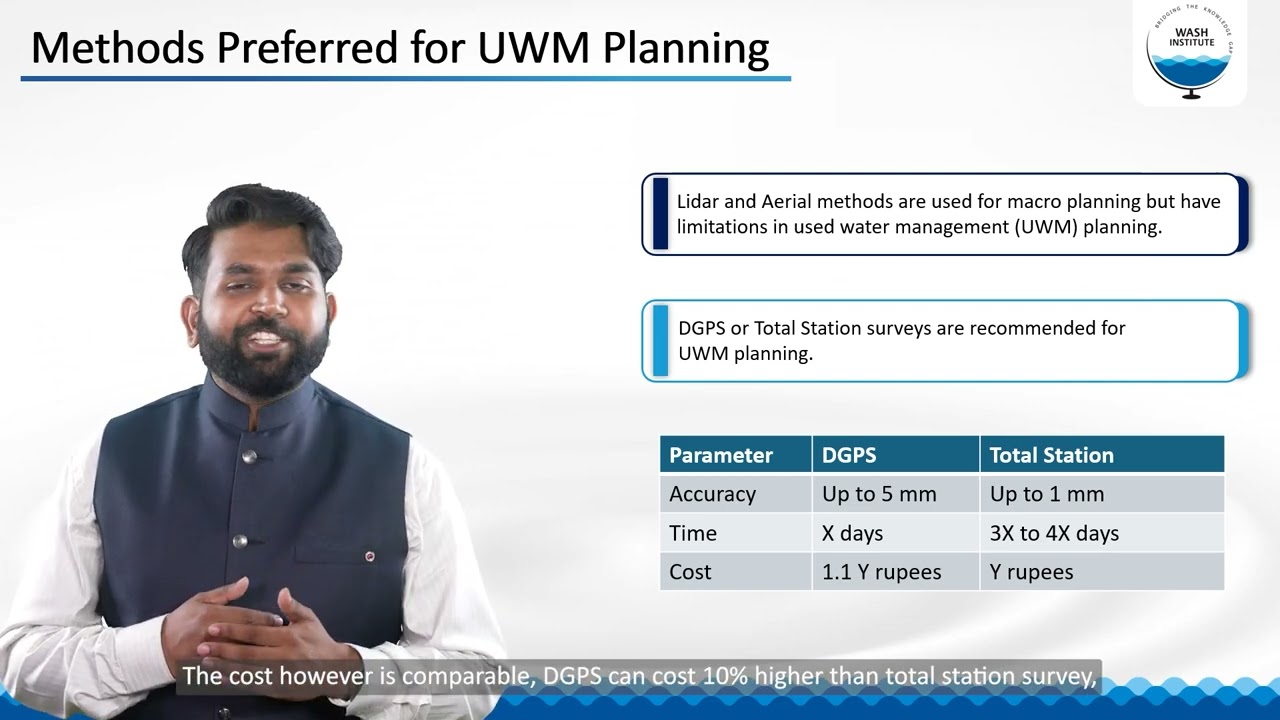
Accurate mapping of the town's topography is essential for planning sewer networks and trunk line alignments. It facilitates efficient interlinkage of drain endpoints through gravity, reducing capital and operating costs. Consequently, precise maps of roads, elevations, and discharge points are necessary.
Tool:
Once the sites for the STP and pumping stations are identified, a detailed geotechnical test must be conducted to assess the soil profile and its bearing capacity. This information aids in designing the structural components of the infrastructure, which is a prerequisite for costing and tendering.
Gap Analysis
Used water management infrastructure, such as treatment plants, pumping stations, and sewer lines, must be designed with future used water generation in mind. These components have varying life spans, as specified by the CPHEEO. This section offers tools for local governments to forecast their population based on historical data and the town's profile.
Tools:
Once the population is estimated for the design period, current and futuristic wastewater and faecal sludge generation must be calculated. These calculations help arrive at the capacity of the conveyance and treatment infrastructure. Various tools can be used to calculate this, either from a generation point of view or from current demand. This section provides all these tools.
Tools:
Data collected so far can be used to assess the town’s risk profile based on the potential impact of pollution from used water on drinking water sources. A low-risk profile indicates that the quantity of used water affecting groundwater is insignificant and can be managed through cost-effective measures. This section provides step-by-step guidance on using data to assess the risk.
Tools:
Once the forecasted used water generation is determined, risks are identified, and existing infrastructure is evaluated. Consequently, local governments can identify the gaps in conveyance and treatment infrastructure and plan for the new or retrofitting of existing systems to enhance capacity. This section assists users in systematically identifying the gaps across various components of the sanitation value chain.
Project Formulation
Based on the risk profile and the gap, to achieve 100% used water management, i.e., to attain ODF++ status, users can utilise the tools and guidance in this step to develop a comprehensive list of infrastructure requirements for their town. This includes the conveyance and treatment of both used water and faecal sludge.
This stage assists local governments and decision-makers in prioritising the extensive list of UWM projects identified in the previous step. Prioritisation may depend on various factors, such as financial and human resource capacity, public and political importance, environmental and health urgency, and more.
Stage 2: DPR preparation
Once projects are identified, each is detailed according to engineering specifications from the CPHEEO Manual on Sewerage and Sewage Treatment Systems 2013. Detailed project reports include an engineering plan and budget estimate for approval. To foster innovative solutions, DPRs should avoid prescriptive technologies and focus instead on design considerations and outputs
Using the process below, local governments will be able to develop DPRs which align with SBM 2.0 guidelines and can be used for DBOT type of procurement
Stage 3: Procurement – bid management
Once the detailed project report has been approved by the relevant authorities, tender documents must be prepared to invite agencies for the Design, Build, Operate and Transfer (DBOT) process. Local governments may use the model templates provided below to prepare these documents.
- Model DBOT RFP (Coming soon)
- Standard Design and Estimates for UWM projects
- Tender evaluation criteria/tool (Coming soon)
Stage 4: Construction Stage
Once an agency is selected for DBOT and work is awarded, local governments have the responsibility to monitor the quality, scope and timeline of implementation. The tools under this section will assist urban local governments with this process.
Tools available:
- Checklist for design review and vetting (Coming soon)
- Checklist for Construction readiness – Land, drawing
- Checklist for construction quality monitoring (Coming soon)
- Checklist for construction completion and handover (Coming soon)
- Checklist for commissioning and trial runs (Coming soon)
Stage 5: Operation and maintenance
Once the infrastructure is commissioned, the local government ensures sustainable operations by monitoring adherence to design standards, pollution control norms, economic efficiency, and safety standards. This section offers checklists and templates for continuous monitoring and reporting of UWM assets.
Tools :
- Checklist for O&M monitoring (Coming soon)
- Checklist for asset transfer (Coming soon)